Most test fixtures aren’t reusable.
They get rebuilt every time. Different wiring. Different scripts. Same problems.
It doesn’t have to be that way.
1. It’s mostly in the software
The hardware doesn’t make a fixture reusable.
The software does.
If your logic is rigid, the system is disposable. If your logic is flexible, the hardware becomes a platform.
2. Define the I/O — not the test
Stop building for one scenario.
Define:
- inputs
- outputs
- control points
If those are stable and configurable, the fixture can support different tests without being rebuilt.
3. Move critical timing to the peripherals
Trying to handle timing-critical behavior directly in Linux is where things often break down.
Let the hardware handle:
- fast loops
- deterministic timing
- signal-level control
The Pi should coordinate the system—not chase microseconds.
4. Log everything — consistently
If it’s not logged, it didn’t happen.
You want:
- time-stamped data
- events and values together
- one consistent format
Because whether it succeeds or fails, the data is the only proof you have.
5. Make everything a property
Nothing should be hardcoded.
- engineering-unit scaling
- calibration
- channel names
- precision
If it can change, it should be configurable.
That’s what separates a one-off setup from a reusable system.
6. Make the UX part of the system
Not something you bolt on later.
You need visibility into:
- system state
- I/O behavior
- changes over time
If you can’t see what’s happening, you’re guessing.
7. Build for automation from day one
Manual steps = mistakes.
If your process depends on:
- clicking through steps
- watching timing manually
- “doing it the same way every time”
…it’s not a system. It’s an accident waiting to happen.
A real fixture:
- runs itself
- enforces timing
- logs the result
- resets for the next test
Conclusion
A reusable fixture isn’t about making one test easier.
It’s about building a system that can run any test without starting over.
Same hardware. Same structure. Different tests.
That’s the difference between a setup… and a system.
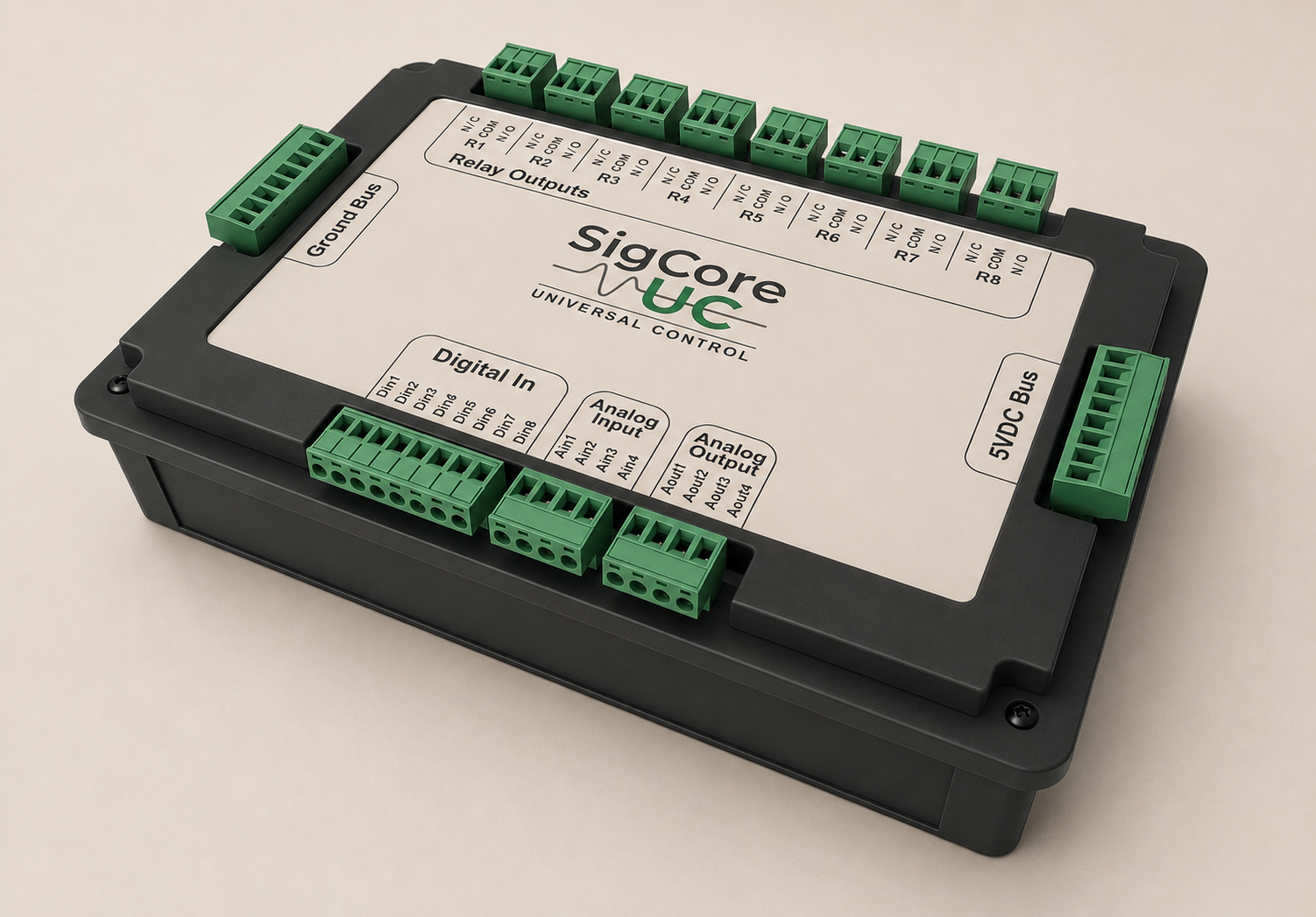
SigCore UC was built around these principles: SigCore UC