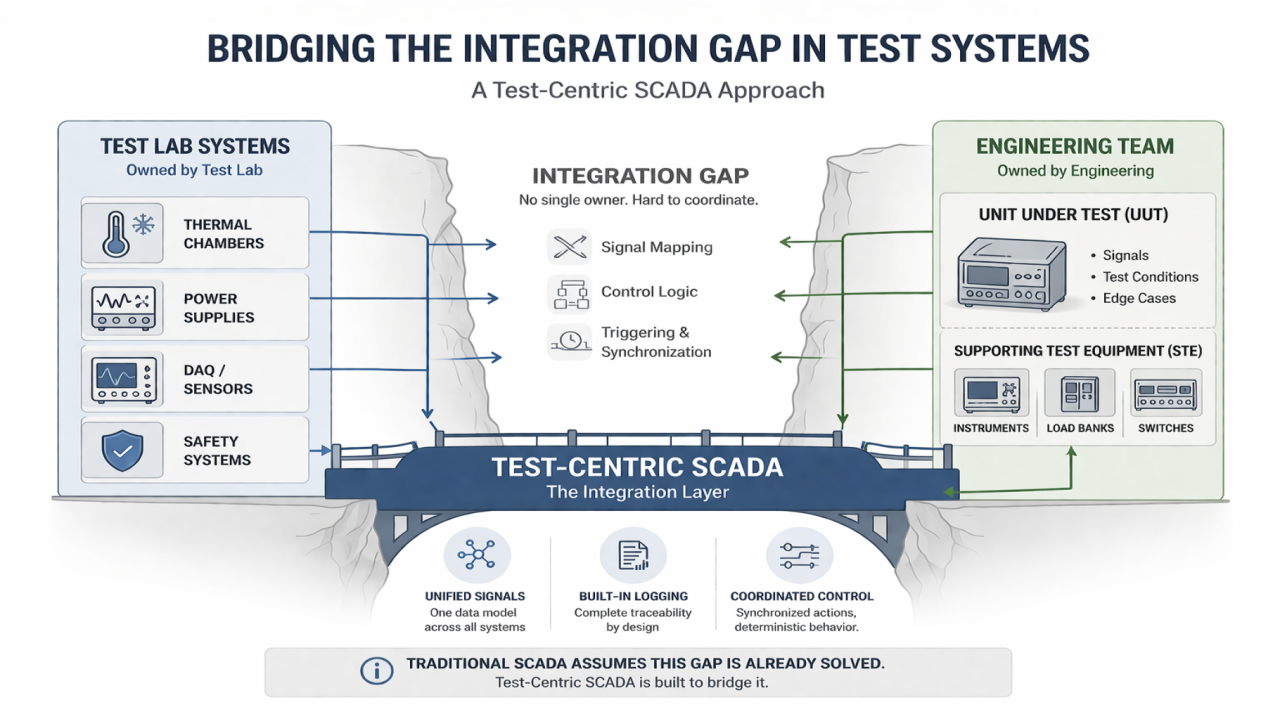
It is often assumed that running the test is the most challenging aspect of testing. In practice, the greater challenge lies in making all system components work together.
Test labs and engineers each address part of the problem, but no single entity owns the system as a whole. As a result, integration is left unresolved.
That gap is solvable—but it requires a different approach.
1. The Integration Gap in Test Systems
Test environments are typically supported by two distinct domains of expertise:
- Test labs manage and operate infrastructure such as thermal chambers, power systems, data acquisition hardware, and safety systems. Their focus is on reliable operation and repeatability of the test environment.
- Engineers define the behavior of the unit under test (UUT), including required signals, operating conditions, and evaluation criteria.
These domains are complementary but largely independent. The test lab is not responsible for understanding the internal behavior of the UUT, and the engineer is not responsible for configuring or maintaining the test infrastructure.
As a result, no single entity owns the integration of the full test system.
This division of responsibility introduces a coordination layer that must be resolved for each test. Signal mapping, control logic, triggering conditions, and data collection are often implemented through a combination of manual configuration, ad hoc scripting, and iterative adjustments between teams.
Traditional Supervisory Control and Data Acquisition (SCADA) systems are not designed to address this condition. SCADA platforms assume a pre-defined system architecture, with known I/O mappings, stable signal definitions, and persistent configurations. They are optimized for monitoring and supervising established systems, not for assembling temporary or evolving ones.
In test environments, however, the system itself is frequently constructed on demand. Each new test may introduce different signal requirements, control strategies, and measurement objectives.
The integration gap—between infrastructure and UUT definition—is therefore not incidental; it is inherent to the test process.
2. The Missing Integration Layer
The limitation in current test systems is not a lack of capable hardware or software. Modern laboratories are equipped with advanced instrumentation, and engineers have well-developed tools for defining and evaluating UUT behavior.
The challenge lies elsewhere.
What is missing is a shared system that enables both the test lab and the engineering team to define, coordinate, and execute a test together.
Today, this responsibility is typically addressed through a combination of manual configuration, custom scripts, and iterative communication between teams. Signal mappings are defined ad hoc, control logic is implemented externally, and data collection is often added as a secondary step.
In many cases, this gap is not resolved—it is worked around.
Engineers often focus exclusively on acquiring data from the UUT, bypassing or minimally integrating with test lab systems. At the same time, test labs operate their infrastructure independently, without incorporating supporting test equipment (STE) or UUT-specific context into a unified system.
As a result, the definition of a test remains fragmented across multiple tools and domains, with each side operating within its own scope of responsibility.
An effective solution requires the introduction of an intermediate layer—referred to here as an integration layer or test definition layer—that operates between test infrastructure and the UUT.
This layer serves several key functions:
- Establishes a common representation of signals and system state
- Defines control logic, sequencing, and triggering in a centralized manner
- Coordinates data acquisition and logging as part of the test definition
- Provides a shared interface accessible to both lab personnel and engineers
Rather than assuming a fixed system configuration, this layer enables the system to be defined as part of the test itself.
In this model, the test is no longer an overlay on top of disconnected components. It becomes a structured, executable definition that integrates all participating elements.
This approach shifts the focus from assembling systems to defining and running tests within a unified framework.
3. System Requirements for a Test-Centric SCADA
3.1 Fast System Assembly
A test-centric SCADA system must support rapid system assembly with minimal configuration overhead. In test environments, system composition changes frequently, and setup time directly impacts productivity.
New I/O must be incorporated quickly. Devices and channels should be added without requiring extensive manual configuration, custom data modeling, or per-test software development.
Signal mapping must be direct and low-friction. Inputs and outputs should be assignable in a transparent manner, without reliance on complex tag hierarchies or rigid naming structures. The system should allow signals to be defined and used immediately, with refinement applied as needed.
Configuration depth must be minimized. Traditional SCADA systems often require substantial upfront definition of communication parameters, scaling, and tag databases. In a test environment, this introduces unnecessary delay. Instead, configuration should be incremental, allowing the system to become operational before all details are finalized.
In practice, many devices expose proprietary or vendor-specific interfaces. A test-centric SCADA system must accommodate this by incorporating a translation layer that converts device-specific protocols into a common internal signal model. This enables new equipment to be integrated once and reused across multiple test configurations without repeated implementation effort.
The objective is to align software readiness with physical setup.
A test system should become operational at approximately the same pace that hardware is connected. Software configuration should not be the limiting factor in initiating a test.
3.2 Shared Understanding
A test-centric SCADA system must provide a shared representation of the test environment that is accessible and meaningful to both the test lab and the engineering team.
In current practice, each group operates within its own context. Test labs interact with physical equipment—channels, voltages, relays, and instrumentation—while engineers think in terms of functional signals, behaviors, and test conditions. Bridging these perspectives typically requires manual interpretation and repeated communication.
The system must eliminate this disconnect.
Signals should be represented in a way that preserves both their physical origin and their engineering meaning. A single signal should carry:
- its source (device, channel, interface)
- its physical characteristics (units, scaling, limits)
- its functional role within the test (e.g., “Chamber Temperature”, “UUT Enable”, “Fault Status”)
This allows the same system to present different views of the same underlying data:
- A lab-oriented view focused on hardware and connectivity
- An engineering-oriented view focused on behavior and test intent
These are not separate systems or mappings, but coordinated perspectives of a single, unified model.
By maintaining a common representation, the need for manual translation between domains is removed. Both groups operate on the same signals, reducing ambiguity and ensuring consistency in control, measurement, and data interpretation.
The result is a system in which physical implementation and engineering intent are inherently aligned, rather than reconciled after the fact.
3.3 Built-In Coordination
A test-centric SCADA system must provide integrated coordination of control, data acquisition, and test execution functions within a single environment.
In many existing implementations, these functions are distributed across multiple tools. Control is handled by dedicated controllers or PLCs, data logging is performed by separate software, and triggering or sequencing logic is implemented through custom scripts or external systems. These components are then combined through ad hoc integration.
This fragmented approach introduces complexity, increases setup time, and creates multiple points of failure.
A test-centric system must instead provide these capabilities as native, coordinated functions:
- Control Coordination: Supervisory control over existing controllers (e.g., PID loops, PLC logic), including setpoint management, mode control, and command sequencing. The SCADA system does not replace embedded or real-time control systems; it coordinates and directs them within the context of the test.
- Logging: Integrated data acquisition and storage as part of the test definition, not as an external add-on
- Triggering: Event-based actions driven by signal conditions, time, or state transitions
- State Awareness: Explicit representation of system and test states (e.g., idle, running, faulted, complete)
These functions must operate on a common signal model, ensuring that control coordination, logging, and triggering are inherently synchronized.
The system should not require external tools to define or execute test behavior. Instead, it should provide a cohesive environment in which the test can be configured, executed, and monitored as a unified process.
The objective is not to replace existing control systems, but to eliminate the need for stitching together independent tools. This results in a single supervisory system that coordinates how a test is executed, while leveraging the capabilities of the underlying controllers.
3.4 Temporary by Design
A test-centric SCADA system must be designed with the expectation that system configurations are transient.
In contrast to traditional SCADA environments—where systems are engineered for long-term stability, fixed I/O mappings, and persistent configurations—test systems are inherently dynamic. Each test may introduce new equipment, different signal requirements, and modified control strategies. As a result, the system is routinely assembled, adjusted, and disassembled.
This behavior is not an exception; it is fundamental to the nature of test environments.
The system architecture must therefore assume that configurations will be created, modified, stored, recalled, and discarded as part of normal operation. Rigid, persistent configuration models introduce friction in this context and slow down iteration.
To support this, a test-centric SCADA system should:
- Allow rapid creation and removal of system configurations without impacting other tests
- Support reuse through templates and modular components rather than fixed system definitions
- Separate reusable infrastructure (e.g., device interfaces, signal adapters) from test-specific configuration
- Enable versioning or snapshotting of test setups for repeatability without enforcing permanence
The system should treat each test configuration as a self-contained, executable definition that can be instantiated, reused, and retired as needed.
This represents a fundamental shift from traditional SCADA design.
Rather than optimizing for permanence and long-term operation, the system must optimize for speed, flexibility, and repeatability across changing configurations.
3.5 Immediate Visibility
A test-centric SCADA system must provide immediate and unambiguous visibility into system and test status.
In many test environments, determining the current state of a system requires interpretation of multiple indicators, logs, or device-specific interfaces. Operators and engineers are often forced to infer whether a test is running correctly, whether conditions are stable, or whether a failure has occurred.
This lack of clarity introduces delay and increases the risk of incorrect conclusions or missed events.
The system must instead present a clear, real-time view of operational status, answering fundamental questions without ambiguity:
- Is the test running?
- Are conditions stable and within expected limits?
- Has a fault or failure occurred?
To support this, the system should:
- Provide explicit system and test state indicators (e.g., idle, initializing, running, stabilizing, faulted, complete)
- Surface critical conditions and deviations immediately, without requiring log inspection
- Correlate control actions, measured data, and system responses in a unified view
- Distinguish between normal transitions and abnormal conditions
Visibility must be derived from the same underlying signal model and coordination logic used to execute the test. This ensures that the reported state reflects actual system behavior, not a disconnected or delayed representation.
The objective is to eliminate the need for interpretation.
At any point during operation, a user should be able to determine the status of the test and the system at a glance, without cross-referencing multiple tools or data sources.
4. The Shift
Traditional SCADA systems are designed for stable environments with fixed configurations and long operational lifetimes.
Test environments operate differently. System configurations are routinely created, modified, and replaced as part of normal operation.
As a result, the priorities of the system must change.
A SCADA system intended for test environments must be designed to support continuous redefinition, rather than long-term stability. This requires prioritizing setup speed, flexibility, and reuse over permanence and rigid configuration.
This shift is not an enhancement to traditional SCADA design. It is a change in how the system is defined.
5. Context and Evolution
The concepts described in this paper are not theoretical.
They are the result of practical experience developing and working with test systems across a range of applications. In these environments, the fragmentation between test infrastructure and UUT-specific requirements consistently led to increased setup time, complexity, and reduced visibility.
Over time, incremental solutions were applied to address these challenges, including custom integration layers, reusable test frameworks, and unified signal models. While effective in specific cases, these approaches were often constrained by the underlying assumptions of traditional SCADA and control architectures.
This paper represents a further evolution of those efforts.
Rather than extending existing systems, it outlines a model in which test definition, system integration, and execution are treated as a single, coordinated function. The goal is not to replace established technologies, but to define an approach that better aligns system design with the operational realities of test environments.
6. Conclusion
The challenge in test environments is often assumed to be execution—running the test, collecting data, and evaluating results.
In practice, the greater challenge lies earlier in the process.
Test systems must first be assembled, integrated, and coordinated across multiple domains before any meaningful execution can occur. This effort is repeated for each new test, introducing variability, delay, and unnecessary complexity.
As demonstrated throughout this paper, these challenges are not the result of insufficient tools or capabilities, but of a mismatch between system design and system use.
Traditional SCADA systems are optimized for stable, predefined environments. Test environments, by contrast, require systems that can be rapidly defined, modified, and reconfigured as part of normal operation.
Addressing this gap requires a shift in how these systems are approached.
A test-centric SCADA system prioritizes integration, coordination, and flexibility, enabling test configurations to be created and executed as unified definitions rather than assembled from disconnected components.
It is often assumed that running the test is the most challenging aspect of testing. In reality, the primary challenge lies in establishing an environment where tests can be rapidly deployed and produce meaningful, reliable results.